An Eight-Year Collaboration
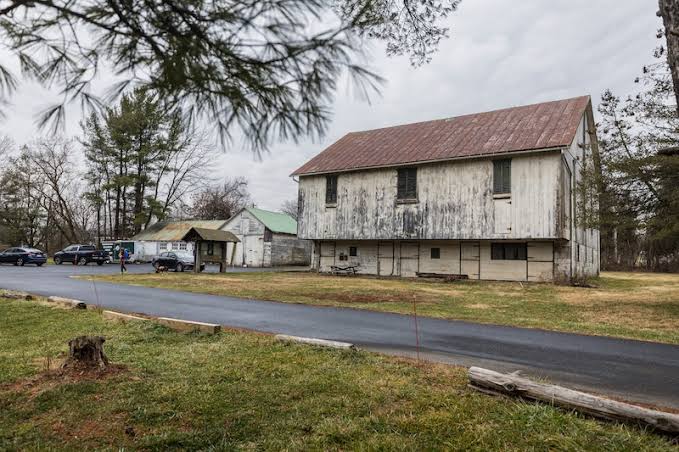
The Scott Farm is a trailhead in Cumberland County along the Appalachian National Scenic Trail (AT), which was acquired by the National Park Service (NPS) over 30 years ago. For three decades, the farmhouse, outbuildings, and historic barn at the Scott Farm were a home to the Appalachian Trail Conservancy’s (ATC) volunteer Mid-Atlantic Trail Crew, provided tool storage for ATC and the Cumberland Valley Appalachian Trail Club (CVATC), and offered a space to conduct skills training for volunteers and a meeting place for trail organizations. The property has also provided public access to the Appalachian Trail and the Conodoguinet Creek at one convenient location. Located in Middlesex Township, Cumberland County – the fastest growing county in the Commonwealth – most weekends the parking area is full of cars packed with anglers, paddlers, birders, and of course, hikers.
In 2019, despite the popularity and importance of this property for the local community, the NPS issued a mandate to reduce the infrastructure footprint on its properties through demolition – a mandate which included all the structures at Scott Farm. Overnight, the property was slated for demolition and, at the time, it seemed like this iconic trailhead might be lost forever. The Cumberland Valley Appalachian Trail Club– the organization that maintains the AT in the Cumberland Valley – either needed to find a way to acquire the property from NPS or find a new base of operations along the trail where they could store their tools and host training events. As a public-sector conservation organization, however, the NPS is prohibited from divesting property without receiving another property of equal or greater acreage and containing an equal or greater length of the AT. The CVATC did not own any property that met these criteria, but had heard of a recent project completed by the Central Pennsylvania Conservancy (CPC) that did.
For over 40 years, CPC has been working with landowners to acquire, preserve, and protect natural resources in central Pennsylvania as the region’s premier land trust. The organization has earned a reputation as “problem solvers” in the field of conservation where land preservation is concerned, since projects of this kind are typically multi-year endeavors, which require robust coordination with funders and project partners. “We’re able to accomplish a lot through partnership,” says Land Protection Director, Cameron Weiser. “When an opportunity to protect land comes our way, even if it’s not a good fit for our organization, we do our best to connect partners with resources that will help them achieve their conservation goals.”
In late 2020, CPC completed the purchase of a 404-acre parcel on Peters Mountain in Dauphin County. The lands CPC acquired contained a roughly one-mile segment of the AT, as well as the Peter’s Mountain trail shelter – so it was the perfect candidate for an exchange with NPS. When CVATC made CPC aware of the situation at Scott Farm, the land trust immediately started working to resolve the issue using the property they’d just acquired. First, the ridgetop containing the AT and trail shelter was subdivided from the forested mountainside, and 242 acres of the property were transferred to the Pennsylvania Game Commission to become a part of SGL 211 – the second-largest state game lands in Pennsylvania. From there, CPC began the long process of transferring the remaining 162-acre tract of Peter’s Mountain to NPS in exchange for the 5-acre Scott Farm property.
Being a small-but-mighty trail group, CVATC was not interested in owning and maintaining the entire Scott Farm, instead preferring to focus on its mission of trail maintenance. As CPC began facilitating an exchange with NPS, simultaneous conversations with CVATC about an end holder for the property led to a new vision of the Scott Farm: a community hub that could also serve as headquarters for the Keystone Trails Association (KTA).
KTA, a statewide hiking organization based in South Central Pennsylvania, was an obvious choice to own the property. According to executive director Holly Smith, “The Keystone Trails Association has grown significantly over the past five years, and establishing Scott Farm as our headquarters is a natural fit for this next chapter.”
After over seven years of negotiation and due diligence, as well as government shutdowns, which further delayed the project at intervals, the exchange is finally complete and the Central Pennsylvania Conservancy now owns the Scott Farm. On September 29th, the property will be conveyed to the Keystone Trails Association with an established lease for use by the Cumberland Valley Appalachian Trail Club.
Throughout the project period, KTA has been preparing for this moment by coordinating with partners, raising funds, and working with HRG, Inc. to develop a conceptual master plan for the property. Plans include improvements to the farmhouse that will establish Scott Farm as KTA’s permanent administrative headquarters, while also providing a meeting space for statewide conservation partners, a visitors center, and a small gift shop. The grounds will be enhanced for broader public benefit as well, and over the next few years residents and visitors can look forward to expanded parking, native landscaping, a year-round public restroom, and a potable water source.
KTA has been awarded two grants from the Cumberland Area Economic Development Corporation – one supports the development of architectural and civil engineering plans, and another provides partial funding for renovations to the farmhouse. Additional grant proposals are currently pending with the PA Department of Conservation and Natural Resources, the PA Department of Economic Development, and several private foundations to match awarded funding and support the remaining renovation costs. Grants from Cumberland County and South Mountain Partnership and private donations support the acquisition and installation of the public outdoor toilet.
As Pennsylvania is embracing the immense promise of its outdoor recreation economy, Cumberland County can be an epicenter of this sector. With welcoming, attractive, and sensitively and sustainably designed amenities and enhanced structures, the Scott Farm will be a magnet for hikers, a respite for other recreationists (e.g. birding, paddling, fishing, trail running, etc.), an inspiring training center on trail maintenance and outdoor skills, a must-visit destination for tourists, and a dynamic venue for meetings of trail, conservation, and recreation groups.
During this transition, the Scott Farm will continue to be accessible by the public as a trailhead and creek access point but visitors should be aware the during certain points in the renovation process, parking may be severely limited.
To stay tuned for updates to the Scott Farm project, visit www.kta-hike.org.